
Fascia & Pilates: Why Movement Professionals Need To Think Beyond Muscles
Jul 27, 2026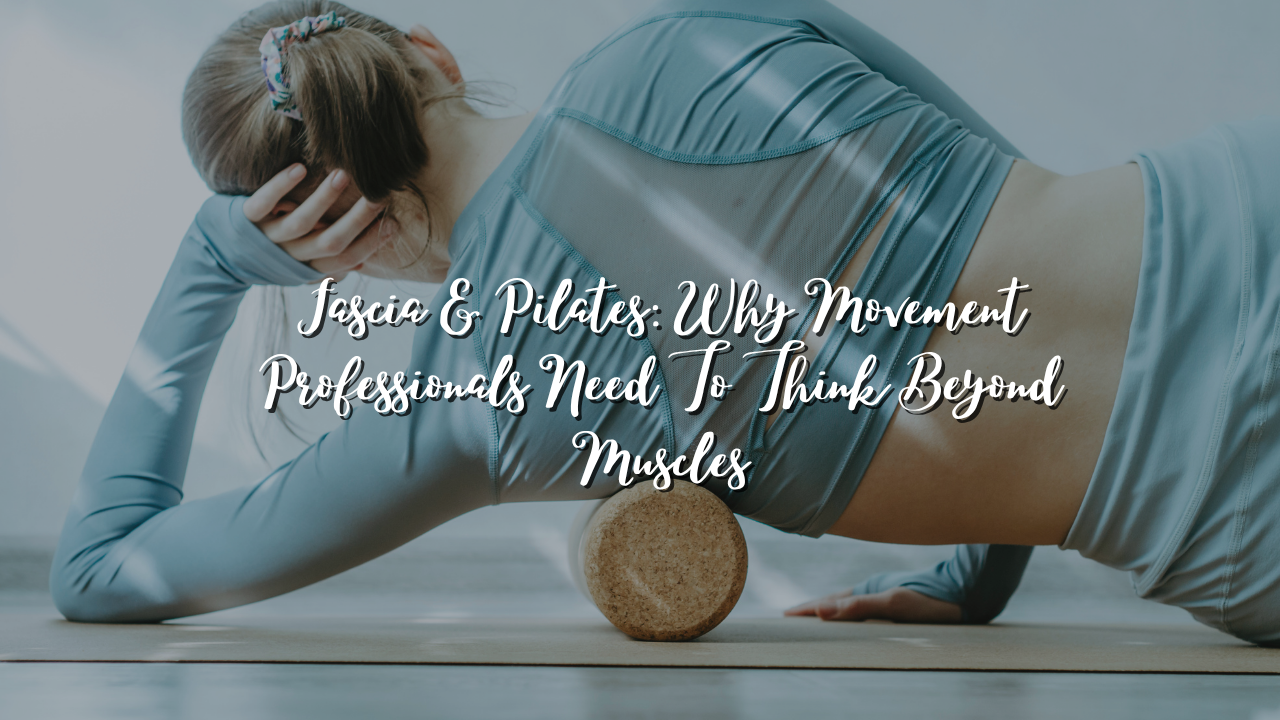
There comes a point in every Pilates professional’s career where anatomy alone stops answering the questions.
You can know every origin and insertion.
You can understand biomechanics.
You can memorise every exercise and modification.
And still find yourself standing in front of a client thinking:
Why is this body not changing?
Why does the client who is “doing everything right” still feel stiff?
Why does somebody become stronger but continue moving poorly?
Why does one shoulder continue gripping no matter how many cues you give?
Why do some clients improve rapidly while others seem trapped in chronic tension patterns for years?
This is where fascia becomes a profoundly important conversation for Pilates professionals.
Not because it is trendy.
Not because it is fashionable.
But because understanding fascia helps explain many of the things experienced movement teachers have been observing clinically for decades.
The Problem With Reductionist Movement Education
Most movement professionals were originally educated through a reductionist lens.
We were taught:
- muscles
- joints
- planes of movement
- isolated actions
- stabilisers versus mobilisers
- strengthening and stretching
And while this foundation matters, it can unintentionally create a fragmented understanding of the body.
Clients do not arrive as isolated body parts.
They arrive as whole systems.
A painful shoulder is not simply a shoulder.
A tight hip is not simply a hip.
A flattened thoracic spine is not merely posture.
The body is adaptive.
Everything influences everything else.
And fascia may be one of the key systems helping explain how these adaptations occur.
Fascia Is The Missing Link In Understanding Force Transfer
One of the most important ideas movement professionals must understand is this:
Movement is not simply muscles pulling on bones.
The body is constantly transferring force through an interconnected fascial network.
This matters enormously in Pilates because Pilates is fundamentally about integrated movement.
Joseph Pilates intuitively understood this long before fascia became a mainstream conversation.
The body does not function in isolated pieces.
It functions through:
- tension relationships
- force distribution
- elasticity
- coordination
- timing
- proprioception
- breath
- pressure systems
- sensory feedback
Fascial tissue helps connect all of these things.
When force transfers efficiently through the body, movement appears fluid, adaptable, coordinated, and effortless.
When force transfer becomes inefficient, compensation patterns emerge.
The body begins gripping, bracing, compressing, or overworking.
And this is often where Pilates professionals start seeing:
- chronic neck tension
- over-recruitment patterns
- rigid posture
- poor load distribution
- movement hesitation
- asymmetrical movement strategies
- balance changes
- reduced rotational ability
- breath restriction
Not because clients are lazy or weak.
But because the system itself has lost adaptability.
Fascia Is Not Just Structural — It Is Sensory
This may be one of the most important shifts in modern movement understanding.
Fascia is richly innervated.
It contains sensory receptors that constantly gather information about:
- tension
- pressure
- load
- direction
- movement
- position
- force
Which means fascia is not simply structural tissue.
It is sensory tissue.
This changes the way we think about cueing entirely.
Many Pilates professionals have experienced clients who:
- cannot “find” muscles
- over-effort constantly
- struggle with proprioception
- grip unnecessarily
- appear disconnected from movement
- cannot replicate movement patterns consistently
Often, we continue trying to solve this with more muscular cueing.
More activation.
More effort.
More correction.
But what if the issue is not muscular at all?
What if the sensory system itself is overloaded, inefficient, or lacking clear information?
This is where Pilates becomes far more than exercise.
Because intelligent Pilates creates sensory experiences.
The springs provide feedback.
The apparatus provides information.
The footbar provides pressure awareness.
The breath changes internal tension systems.
The movement variability improves adaptability.
Pilates, at its best, becomes a conversation between the nervous system and the body.
Why Old Injuries Still Matter
One of the most clinically relevant fascial concepts for Pilates professionals is understanding how old injuries continue influencing movement patterns years later.
A client may no longer consciously think about:
- the ankle sprain from netball
- the C-section scar
- the shoulder dislocation
- the fractured wrist
- the knee surgery
But the body remembers altered tension strategies.
Fascial restrictions can continue affecting movement long after tissue healing occurs.
This is often why:
- one hip continues loading differently
- rotation remains asymmetrical
- one shoulder consistently elevates
- balance feels unreliable
- the thoracic spine remains rigid
- the pelvis continues compensating
This is also why experienced Pilates teachers instinctively observe the entire body rather than chasing symptoms locally.
Because the body reorganises around areas of restriction.
And over time, compensation becomes identity.
Clients begin believing:
“That’s just how my body is.”
But often what we are seeing is not “normal.”
It is adaptation.
Fascia, Aging & The Loss Of Elasticity
Pilates professionals working with older adults already observe this clinically every day.
The body loses spring.
Movement becomes more rigid.
Transitions become slower.
Balance changes.
Rotational movement decreases.
Tissue adaptability reduces.
This is not simply about strength loss.
Fascial tissue itself changes with age.
Hydration changes.
Collagen cross-linking increases.
Glide decreases.
Elasticity reduces.
This matters because fascia helps absorb and distribute force throughout the body.
Without healthy force transfer, joints experience more concentrated loading.
Which may partly explain why stiffness, compression, degeneration, and osteoarthritis become increasingly common with aging.
This is also why Pilates can become profoundly valuable across the lifespan.
Not because it “tones” the body.
But because intelligent movement helps preserve:
- proprioception
- coordination
- variability
- elasticity
- rotational movement
- nervous system adaptability
- balance
- tissue glide
- sensory awareness
Pilates reminds the body how to move through itself.
The Future Of Pilates Requires Deeper Thinking
The Pilates industry is currently at a crossroads.
One path continues reducing Pilates into:
- choreography
- burn
- sweat
- aesthetics
- intensity
- entertainment
The other path asks deeper questions.
Questions about:
- nervous system regulation
- force transfer
- proprioception
- pain science
- tissue adaptability
- fascia
- longevity
- movement literacy
- aging well
- therapeutic movement
- embodiment
And perhaps this is where fascia matters most.
Because fascia reminds us that the body is not separate.
The body is relational.
Integrated.
Adaptive.
Alive.
As Pilates professionals, this requires us to evolve beyond simplistic exercise prescription and become better observers of human movement itself.
Noticing:
- tension patterns
- compensations
- sensory overwhelm
- breath strategies
- load distribution
- movement hesitation
- asymmetry
- rigidity
- fluidity
- adaptability
Because Pilates is not merely about exercises.
It is about helping people restore communication within themselves.
And fascia may be one of the missing links helping us understand why that matters so deeply.
If this topic interests you, continue exploring the evolving research around fascia, movement science, pain, and connective tissue health.
And if you want to dive deeper into these conversations:
🎧 Listen to Episode 83 | Understanding Fascia, Movement & the Missing Link in Human Function with Jack Williams — available on all podcast platforms.
You can also continue the conversation inside The Pilates Muse, where we explore the deeper layers of movement, teaching philosophy, fascia, nervous system health, and the evolving future of Pilates as a therapeutic practice.
Join the Pilates Muse Publication
Explore the world of Pilates through our bi-weekly newsletter, carefully crafted to bring the essence of Pilates directly to your inbox.
Each issue is thoughtfully curated to inspire, educate, and connect you with the timeless principles of Pilates.
See you inside!
We hate SPAM. We will never sell your information, for any reason.

